Essential info at a glance
| Detail | At a glance |
|---|---|
| What it is | The mace-bearing form of Lord Vishnu; the third of the twelve Madhavs of Prayag. |
| Morning session | 6:00 AM to 12:00 PM. |
| Evening session | 4:00 PM to 8:00 PM (midday closure between). |
| Mangala aarti | 6:00 AM to 6:30 AM. |
| Sandhya aarti | 6:30 PM to 7:15 PM (shifts with the sunset). |
| Entry fee | Free. There is no VIP darshan; walk right up to the sanctum. |
| The blessing | Believed to remove the fear of mortality and untimely death. |
| Location | Chhivanki (Cheoki) Village, Naini, near the Chheoki railway junction. |
Gada Madhav timings and aarti
The temple keeps a split day, open from 6:00 AM to noon and again from 4:00 PM to 8:00 PM, with a closure through the middle of the day. Its aartis are its most devotional moments, the Mangala aarti from 6:00 to 6:30 AM, right after the gates open, and the Sandhya aarti from about 6:30 to 7:15 PM, shifting a little with the sunset. Entry is free, and this being a serene village temple, there are no crowds or VIP lines; the devotee may walk right up to the inner sanctum for a close darshan. The most peaceful time is the morning, from about 6:00 to 11:00 AM.
| Detail | When | Notes |
|---|---|---|
| Morning session | 6:00 AM to 12:00 PM | With the Mangala aarti 6:00 to 6:30 AM. |
| Evening session | 4:00 PM to 8:00 PM | With the Sandhya aarti 6:30 to 7:15 PM. |
| Best for peaceful darshan | 6:00 to 11:00 AM | A serene village temple. |
| Entry | Free | No VIP; walk up to the sanctum. |
Sri Gada Madhav: the mace-bearing Madhav
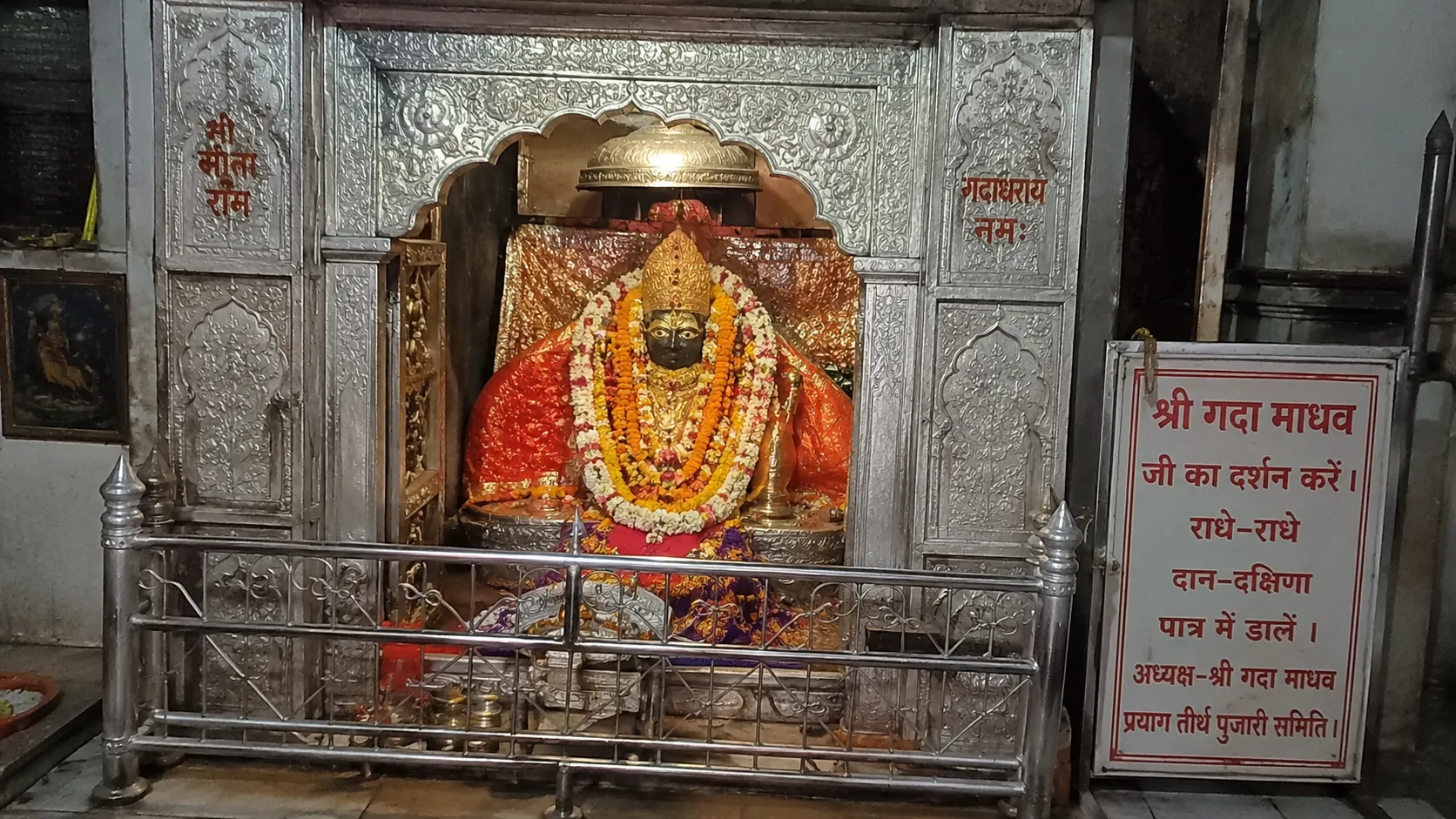
Just as Kashi is called the Shiv Nagari, the city of Lord Shiva, so Prayag is honoured as the Vishnu Nagari, the city of Lord Vishnu, guarded on every side by the twelve Madhavs, the twelve forms of the Lord. And among them, the third, is Sri Gada Madhav, whose ancient temple stands in the village of Chhivanki, in the Naini country across the Yamuna, in the Southern Cluster of the Madhavs. It is a serene and ancient village shrine, far from the bustle of the great city temples, where the Lord is worshipped in a form of quiet and protecting power; and it is a cherished stop for the pilgrim who would complete the full circuit of the guardians of Prayag.
The mace-bearing Vishnu
The name of the deity holds his form and his power. For the Madhavs of Prayag are named each for one of the four sacred emblems that Lord Vishnu bears in his four hands: the Shankha, the conch; the Chakra, the discus; the Padma, the lotus; and the Gada, the mace. And so we have the Shankh Madhav and the Chakra Madhav and the Padma Madhav; and here, the Gada Madhav, the Vishnu of the mace. The Gada, the great mace of Vishnu, called the Kaumodaki, is the mighty weapon with which the Lord crushes the demons and all the powers of evil, and it stands for the invincible, protecting strength of God. So Gada Madhav is the Lord in his mace-bearing, evil-crushing, all-protecting form, a mighty guardian of his devotees and of the holy city.
The Lord who removes the fear of death
From this protecting power flows the special grace for which Gada Madhav is most beloved. For it is the firm belief of the devout that the worship of Gada Madhav, and above all the offering of Tulsi leaves to the Lord in the sacred month of Vaishakh, removes and eradicates the fear of mortality, and guards the devotee against akaal mrityu, untimely and sudden death. For the mace of the Lord, which crushes the demons, crushes also the terror of death itself; and so the devotee comes to Gada Madhav to pray for a full and long life, for protection from sudden harm, and for that deep fearlessness in the face of death that is the gift of faith. It is a beautiful thing to lay one's fears of mortality at the feet of the mace-bearing Lord; and for any real illness, of course, a doctor should always be seen, and the temple visited in faith alongside proper care.
Shayan Mata and the exile of Ram
The ground of Gada Madhav is doubly holy, for beside the temple stands the ancient shrine of Shayan Mata, which marks, the tradition tells, the very spot where Lord Ram, with Mata Sita and Lakshman, rested for a night in the days of his great exile. So this quiet southern corner of Prayag is a station of Ram's own journey, hallowed by his rest; and it takes its place among the many footprints of the exile across this holy land, from Ayodhya to Shringverpur and Prayag and on toward the forest. To bow at Gada Madhav and at the Shayan Mata beside him is to honour both the Lord Vishnu and the Lord Ram, at one sacred spot.
The Dwadash Madhav Parikrama
Gada Madhav is the third of the great company of the twelve Madhavs, and a station upon the Dwadash Madhav Parikrama, the sacred circuit of all twelve that the pilgrims of Prayag undertake for the greatest merit. For it is the belief of the holy city, as with the guardian Hanuman and the presiding Veni Madhav, that the full fruit of the holy bath at the Triveni Sangam is realised only upon the completion of the circuit of the twelve Madhavs, the guardians of Prayag; and the devout, above all in the Magh and the Kumbh, walk the whole round. To include Gada Madhav in the Southern Cluster is part of that great and ancient devotion.
The mace-bearing Lord, in my own words
By Rajeev Sharma, guide with Experience My India
I love taking my pilgrims across the Yamuna to Gada Madhav, because it is a peaceful old village temple, far from the crowds, and the deity is so meaningful. I explain that our Prayag is the Vishnu Nagari, the city of Vishnu, guarded by twelve Madhavs, and that this is the third, the Gada Madhav, the Lord who bears the mace, the weapon that crushes all evil. And I tell them the beautiful belief, that worshipping him, especially offering Tulsi in the month of Vaishakh, takes away the fear of death and guards against untimely death; people find great comfort in that, and I always add that for real illness they must see a doctor too.
And I show them the lovely thing beside the temple, the Shayan Mata shrine, where our Lord Ram rested a night in his exile, so my guests who love the Ram trail feel that connection. For the devout, I fit Gada Madhav into the full Dwadash Madhav Parikrama, our circuit of the twelve, which completes the Sangam pilgrimage. And for my guests who have prayed to Mrityunjay Mahadev in Kashi against untimely death, I tell them here is the Vishnu who gives the same grace at Prayag. A quiet, deep, protecting place, and I love to share it.
In more than forty years of guiding, laying a pilgrim's fear of death at the feet of the mace-bearing Lord here is among the most comforting things I do.
What to see and do
- Take the darshan of Sri Gada Madhav, the mace-bearing Vishnu, at the close village sanctum.
- Offer Tulsi leaves, especially in the month of Vaishakh, and pray against the fear of untimely death.
- Bow at the Shayan Mata shrine beside the temple, where Lord Ram rested in exile.
- Include Gada Madhav in the Dwadash Madhav Parikrama, the circuit of the twelve.
- Enjoy the serene, uncrowded village setting across the Yamuna.
How to reach Gada Madhav
Gada Madhav is at Chhivanki village, in Naini, across the Yamuna, about 8 to 10 km from the city centre, near the Prayagraj Chheoki railway junction; it is reached by road, a short excursion from the city.
| From | Distance | Notes |
|---|---|---|
| Prayagraj city centre / the Sangam | About 8 to 10 km | Across the Yamuna, in Naini; a short excursion. |
| Someshwar Mahadev (Arail/Naini) | In the Naini area | The Moon-Lord Shiva across the river. |
| Prayagraj Chheoki Junction (railway) | Near | The nearest station, in Naini. |
| Prayagraj Junction (railway) | About 8 to 10 km | By auto or taxi over the Yamuna. |
| Prayagraj (Bamrauli) Airport | About 20 km | The city airport; taxis to Naini. |
It is a serene excursion across the Yamuna.
Best time to visit and how to plan it
| When | Why |
|---|---|
| 6:00 to 11:00 AM | The most peaceful time for a close, quiet darshan. |
| The month of Vaishakh (Apr-May) | When the Tulsi offering to remove the fear of death is most auspicious. |
| The Kumbh and Magh Mela | When the Dwadash Madhav Parikrama flourishes. |
| Ekadashi and Dwadashi | The days of Vishnu, especially auspicious for the Madhavs. |
- Pair it with the Sangam and the other Madhavs on the Dwadash Madhav Parikrama.
- Allow time for the excursion across the Yamuna; combine it with the Naini and Arail sites.
For Prayagraj, or a combined Kashi, Ayodhya and Prayagraj pilgrimage, planned end to end, see our Prayagraj temple guide.
Accessibility for elderly and mobility limited visitors
- It is a village temple reached by a road excursion; the drive is easy and the temple generally manageable.
- Come in the cool of the morning for a calm, unhurried darshan.
- The serene, uncrowded setting suits a restful visit for elderly pilgrims.
- We arrange the car and the whole excursion and a gentle pace within your Prayagraj trip.
Etiquette for visiting
- Remove footwear and be reverent; offer Tulsi and your prayers in the Vaishnava custom.
- Be respectful at the Shayan Mata shrine, a Ram site, beside the temple.
- Keep the quiet village temple clean, and follow the priests and any queue in Mela season.
- Keep your phone away in the sanctum, and be considerate of others at worship.
Our guided darshan and Prayagraj tours
We are a Varanasi, Ayodhya and Prayagraj based operator, a unit of Experience My India, with more than forty years of guiding pilgrims across all three holy cities, and our own local guide in Prayagraj. Darshan is free, so what we offer is the experience made smooth and meaningful: the excursion across the Yamuna to the peaceful Gada Madhav, a guide who tells the meaning of the mace-bearing Lord and the Shayan Mata, the full Dwadash Madhav Parikrama for the devout, and the whole Prayagraj and three-city pilgrimage.
| Service | Includes | Price |
|---|---|---|
| Guided Gada Madhav excursion | The trip across the Yamuna, the darshan and the Shayan Mata, with a guide. | Contact us for pricing |
| Dwadash Madhav Parikrama | The circuit of the twelve Madhavs, including Gada Madhav, with a guide and a pandit. | Contact us for pricing |
| Full Prayagraj darshan day | Gada Madhav within a wider Prayagraj visit, with a guide. | Contact us for pricing |
| Kashi, Ayodhya and Prayagraj pilgrimage | The three holy cities, with darshan, transfers and a guide. | Contact us for pricing |
Inclusions and exclusions are stated up front, with any taxes and conditions, and no charge appears later that was not named. Darshan is free; our charge is only for guiding and transport. See all our Ayodhya Varanasi tour packages for the full range.
Experience My India is a travel operator, not the temple administration. Darshan is free; our charge is only for our guiding and transport. Timings and rules are set by the temple and can change.
Nearby sacred sites in Prayagraj
Gada Madhav is one of the twelve Madhavs, in the Southern Cluster across the Yamuna.
| Site | What it is |
|---|---|
| Veni Madhav Temple | The chief of the twelve Madhavs, the presiding Vishnu of Prayag. |
| Adi Vat Madhav | The first of the twelve Madhavs, at the immortal Akshayavat. |
| Someshwar Mahadev (Arail) | The Moon-Lord Shiva, across the Yamuna in Naini. |
| Triveni Sangam | The sacred confluence; the Dwadash Madhav completes the Sangam pilgrimage. |
| Mrityunjay Mahadev (Varanasi) | The Shiva of Kashi who conquers untimely death; the sister grace. |
For the chief and the first of the Madhavs, see our Veni Madhav and Adi Vat Madhav guides.