Brahma's yajna and the twelve guardians
The origin of the twelve Madhavs reaches back to the very dawn of creation. For after Lord Brahma had created the universe, he performed, here at Prayag, the first great yajna, the first cosmic sacrifice of all the ages; and it is from this first sacrifice that Prayag is honoured as the Tirtharaj, the King of all the tirthas.
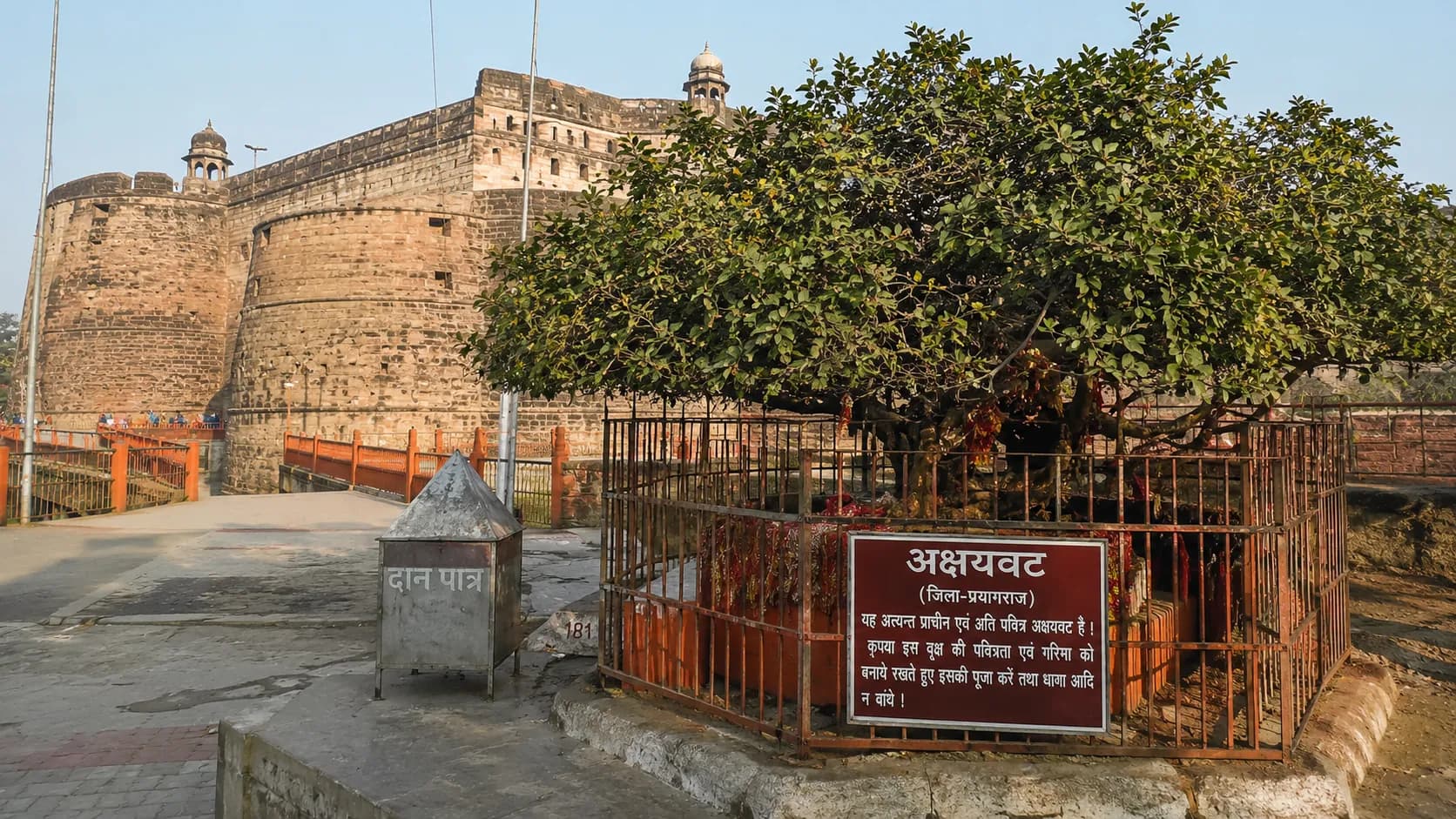
To sanctify this holiest of fields, and to mark and to guard its sacred boundaries, twelve forms of Lord Vishnu were established as the kshetra-palas, the guardians of the sacred field, each set at his own point and in his own direction around the immortal Akshayavat, the deathless tree at the heart of Prayag.
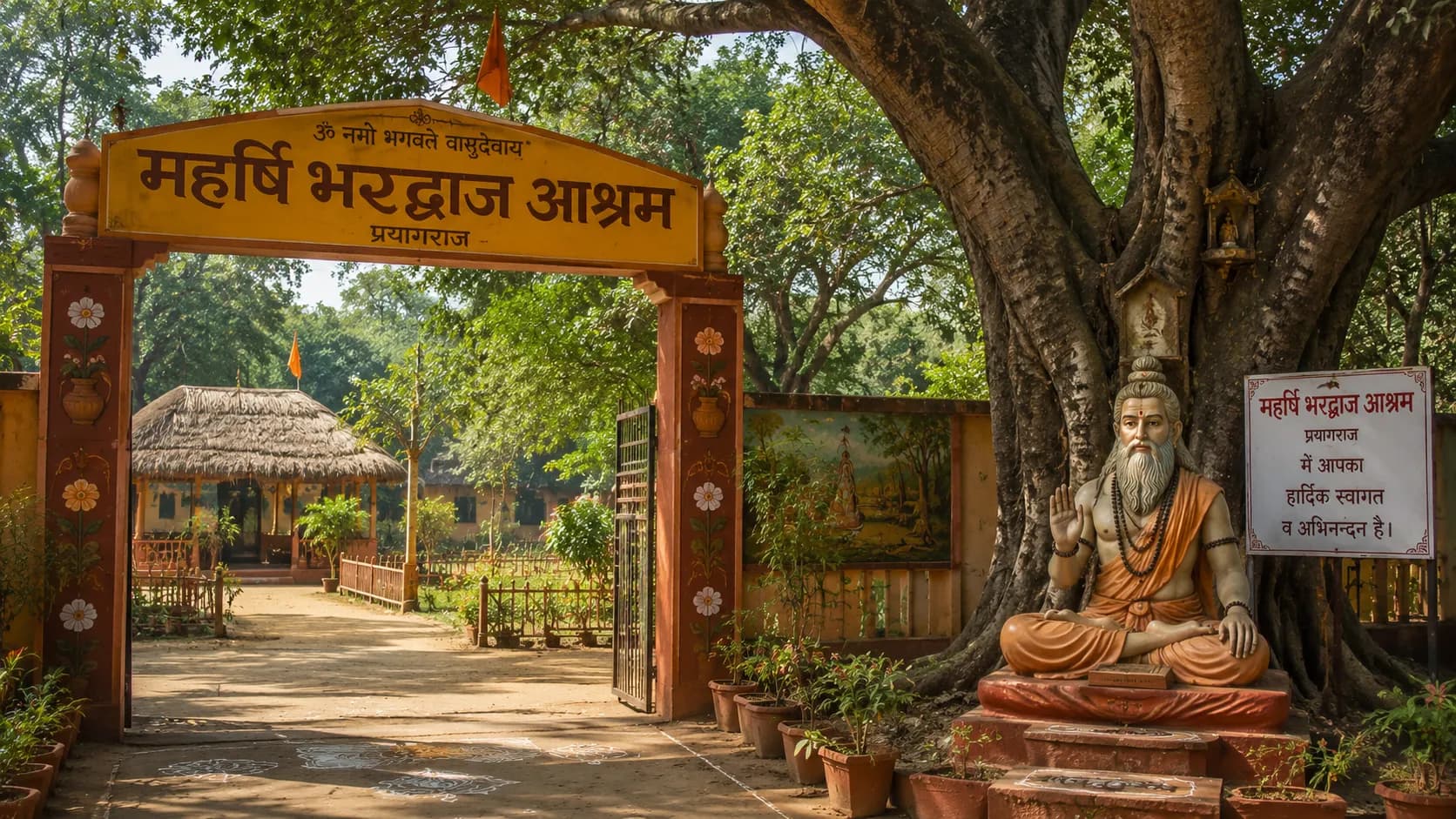
The great sage Bharadwaj, the tradition tells, first began the parikrama of the twelve in the age of the Treta Yuga at his ashram here; through the long centuries the circuit was interrupted, and several of its temples scattered or lost in the Mughal and British ages; but it was lovingly revived in the year 1961 by the saints, and it flourishes today, above all in the holy months of Magh and at the Kumbh.
Why complete the Parikrama?
The Dwadash Madhav Parikrama is held in the highest honour, for three great reasons. The first and greatest is that the full fruit of the holy bath at the Triveni Sangam, and of the Kalpvas, the month-long austerity by the river, is realised, the scriptures tell, only upon the completion of the round of the twelve Madhavs; so the parikrama is the very crown of the Sangam pilgrimage.
The second is that to walk the circuit of the twelve guardians, who together define the whole spiritual perimeter of the holy city, is held equal in merit to encircling the entire cosmos.
And the third is that the Matsya Purana teaches that Vishnu, as Madhav, is the very presiding force over Prayag, and that his twelve forms together govern the liberation of the souls of the ancestors; so that the sacred rites for the departed, the Pind Daan and the Shraddha, performed at the Sangam, reach their highest potency when joined to the worship of the twelve Madhavs.
The twelve Madhavs
Here are the twelve Madhavs, the twelve forms of Vishnu that guard Prayag, each with its distinctive character and its place. Some are the great emblems of the Lord, the conch and the discus and the mace and the lotus; some are his infinite and enchanting qualities; and each has its own grace.
Veni Madhav
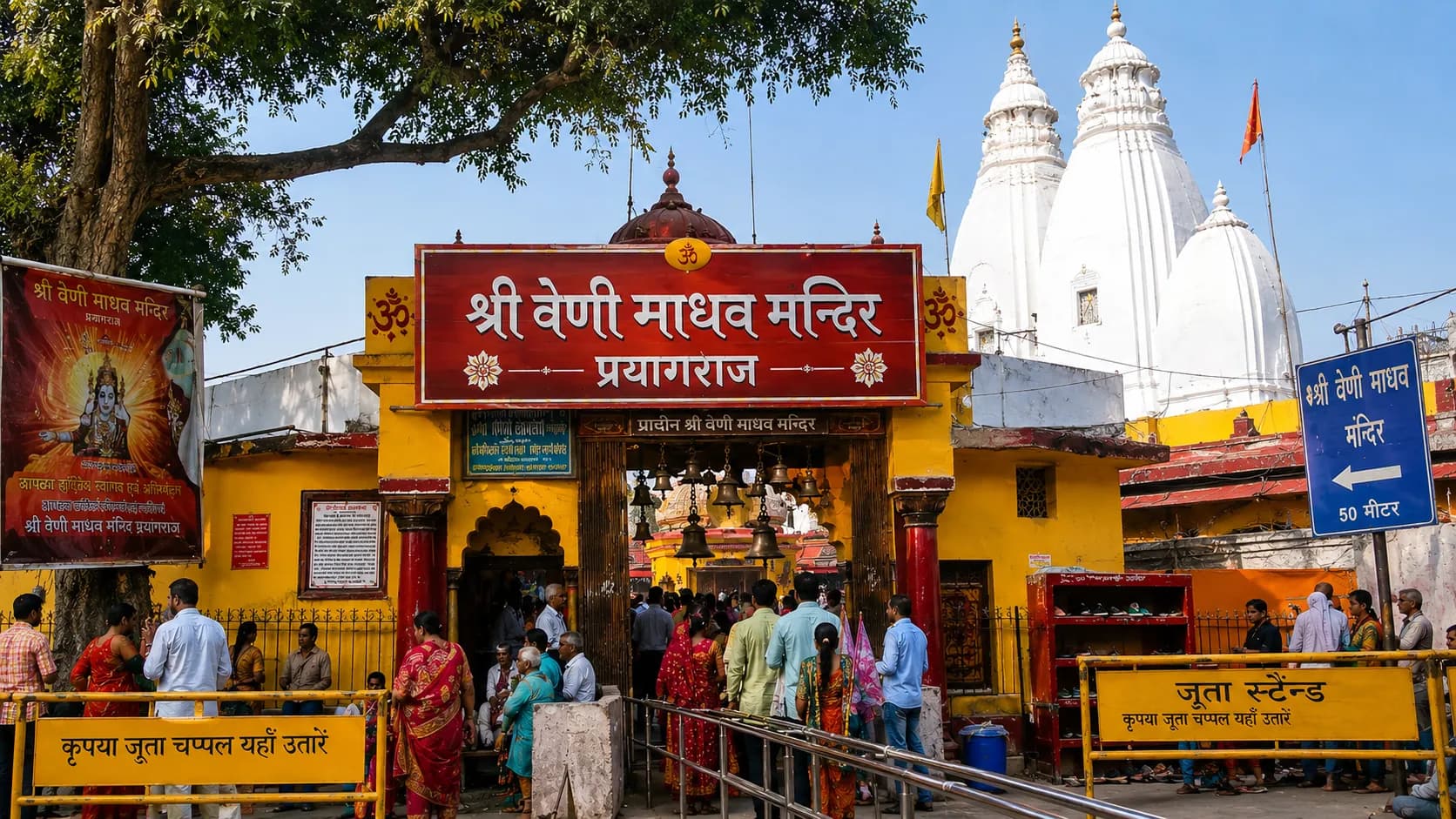
The chief and presiding Madhav, the Nagar Devta, lord of the confluence. Daraganj.
Adi Vat Madhav
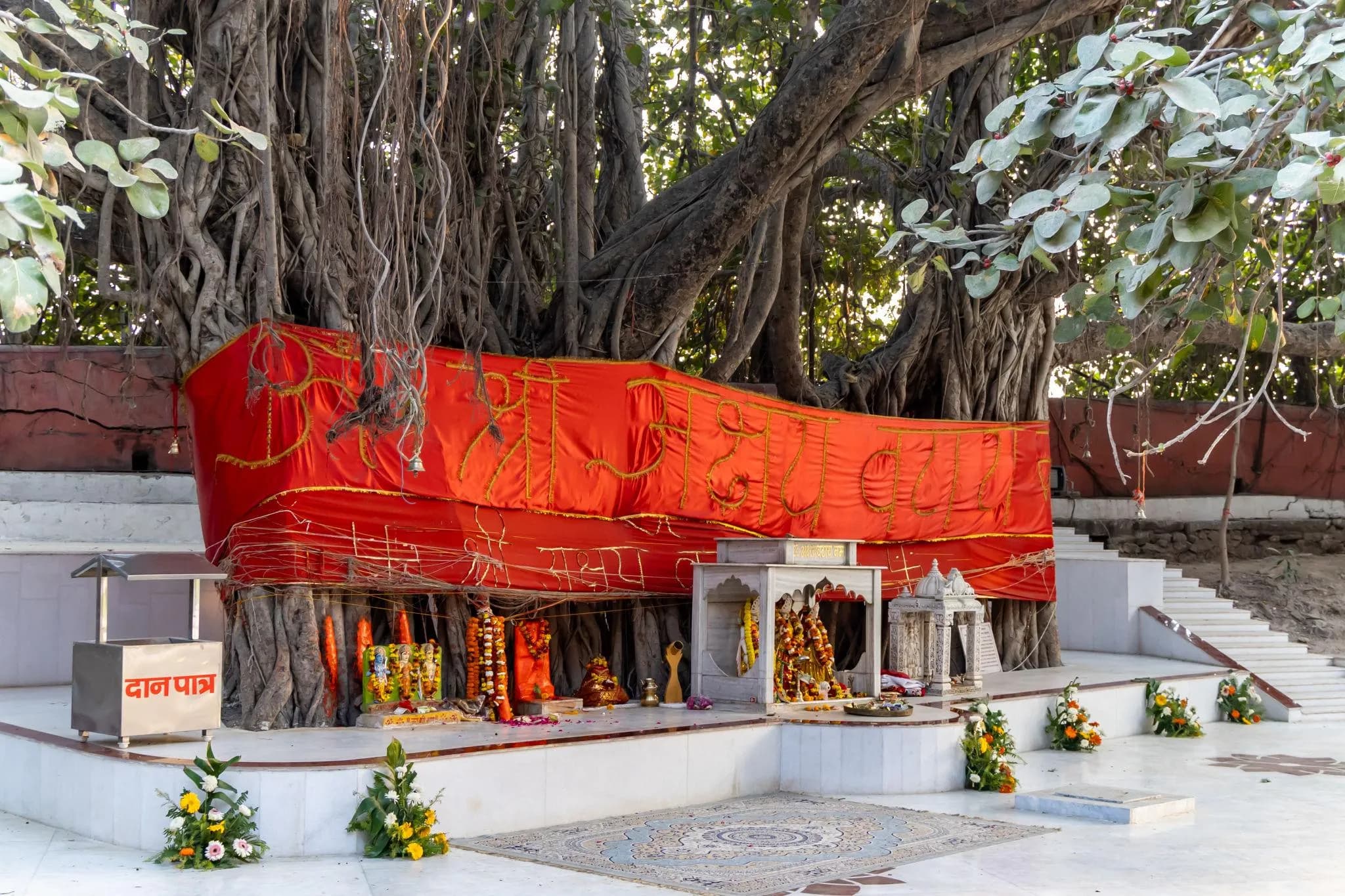
The primal Vishnu of the immortal Akshayavat; a central Madhav. The Fort.
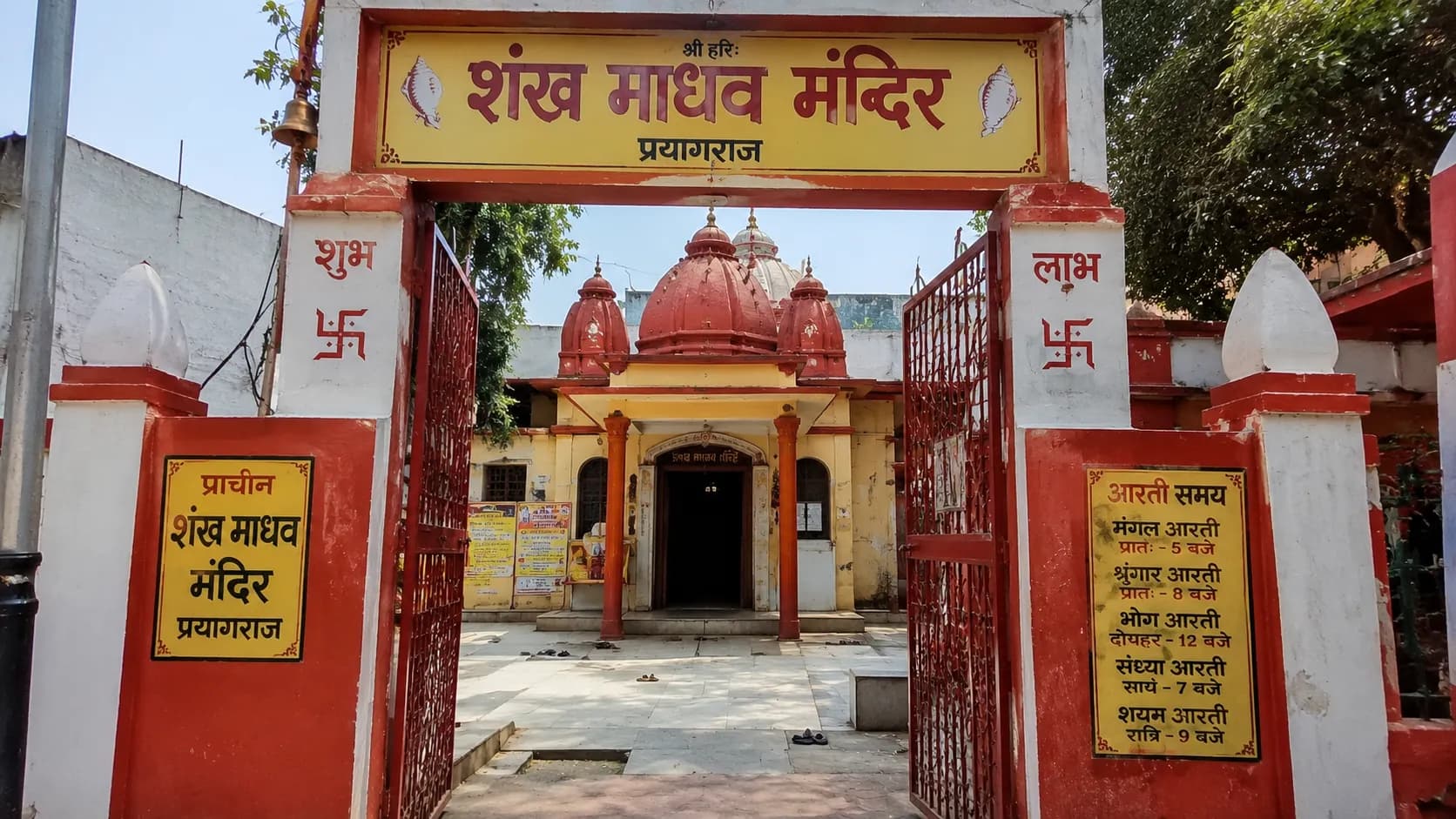
Shankh Madhav
The conch-bearing Lord; the cosmic sound and ultimate purity. Chhatnag, Jhunsi.
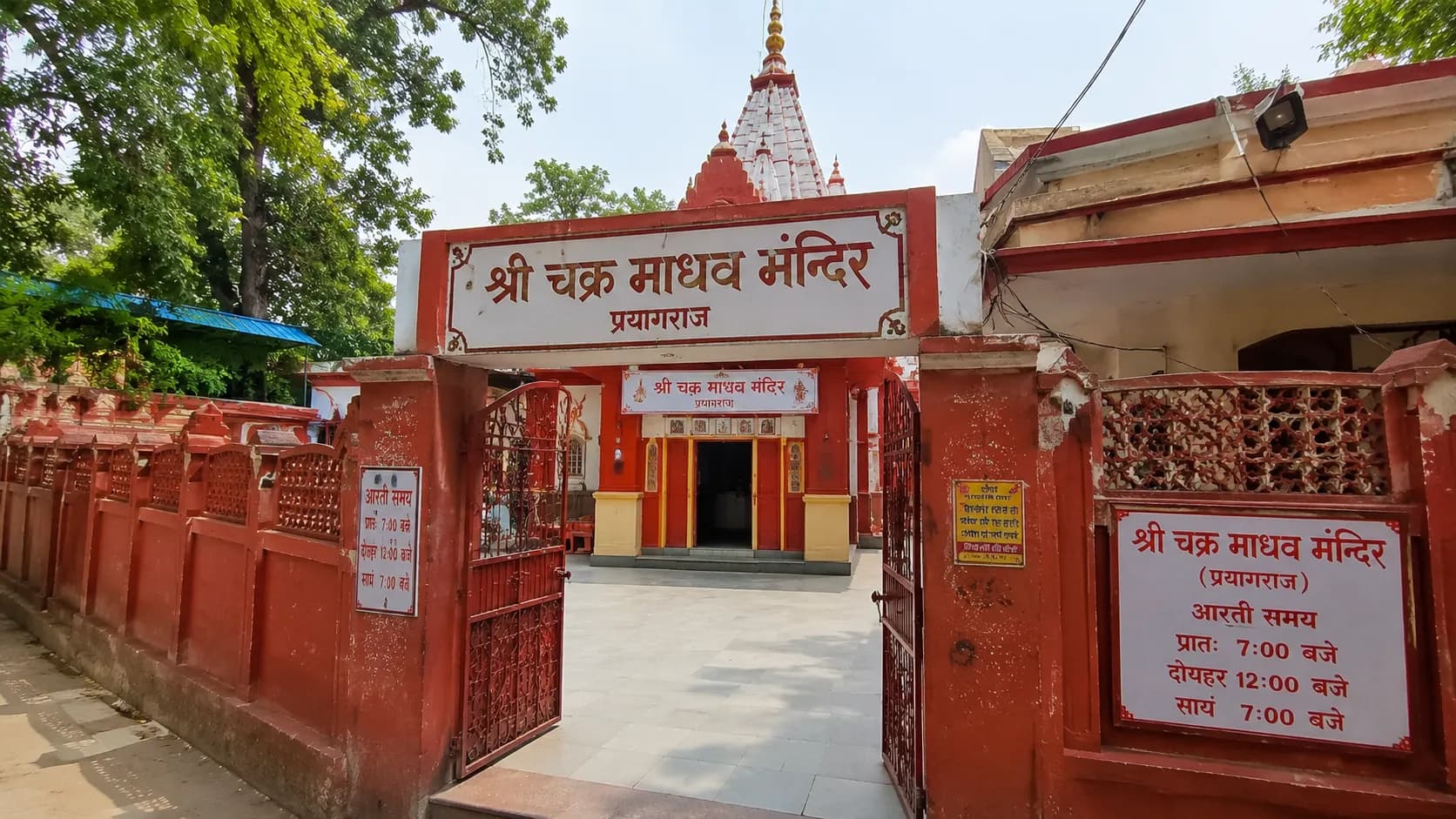
Chakra Madhav
The discus-bearing Lord; the destruction of evil. Arail.
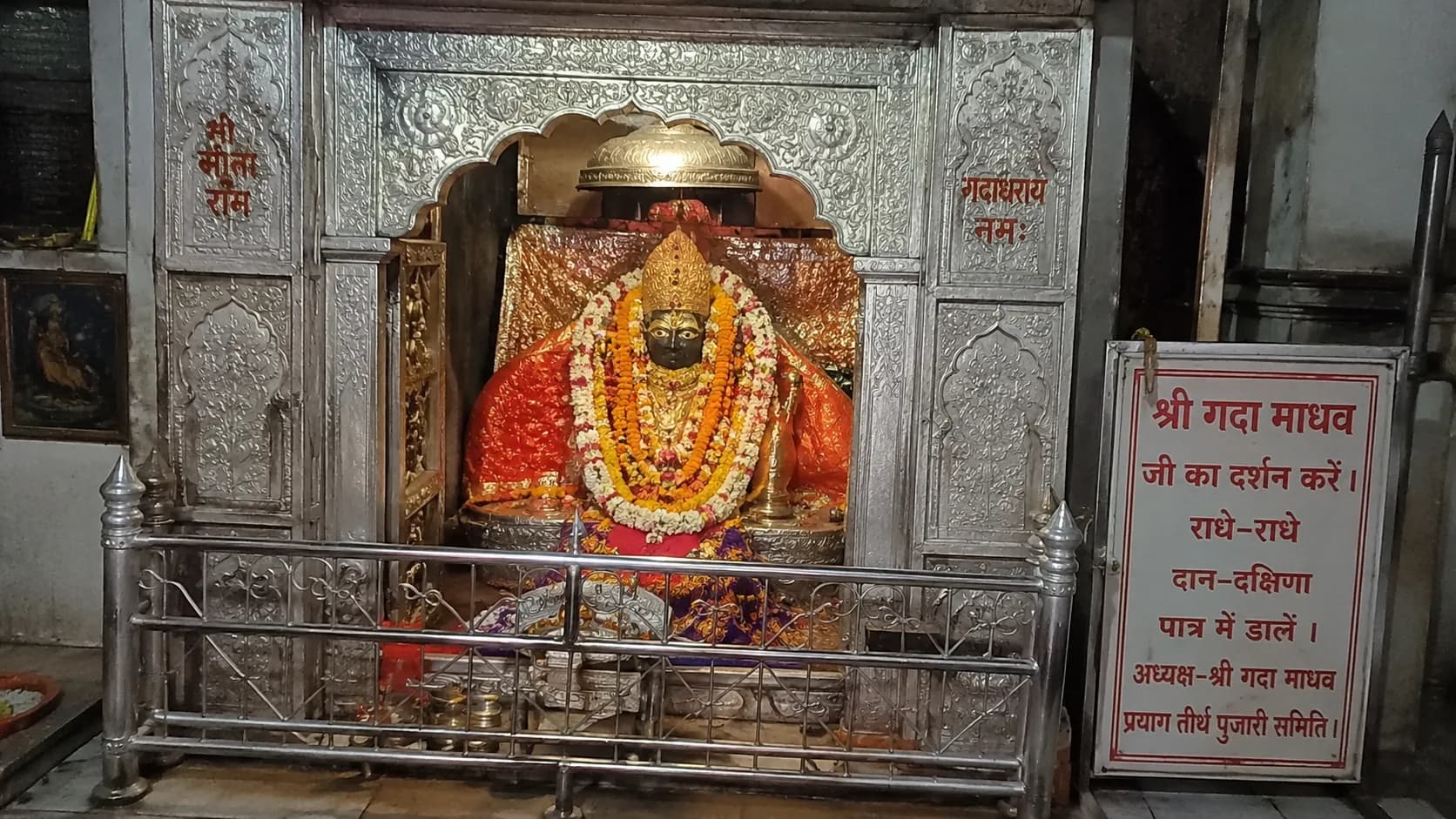
Gada Madhav
The mace-bearing Lord; remover of the fear of untimely death. Chhivanki, Naini.
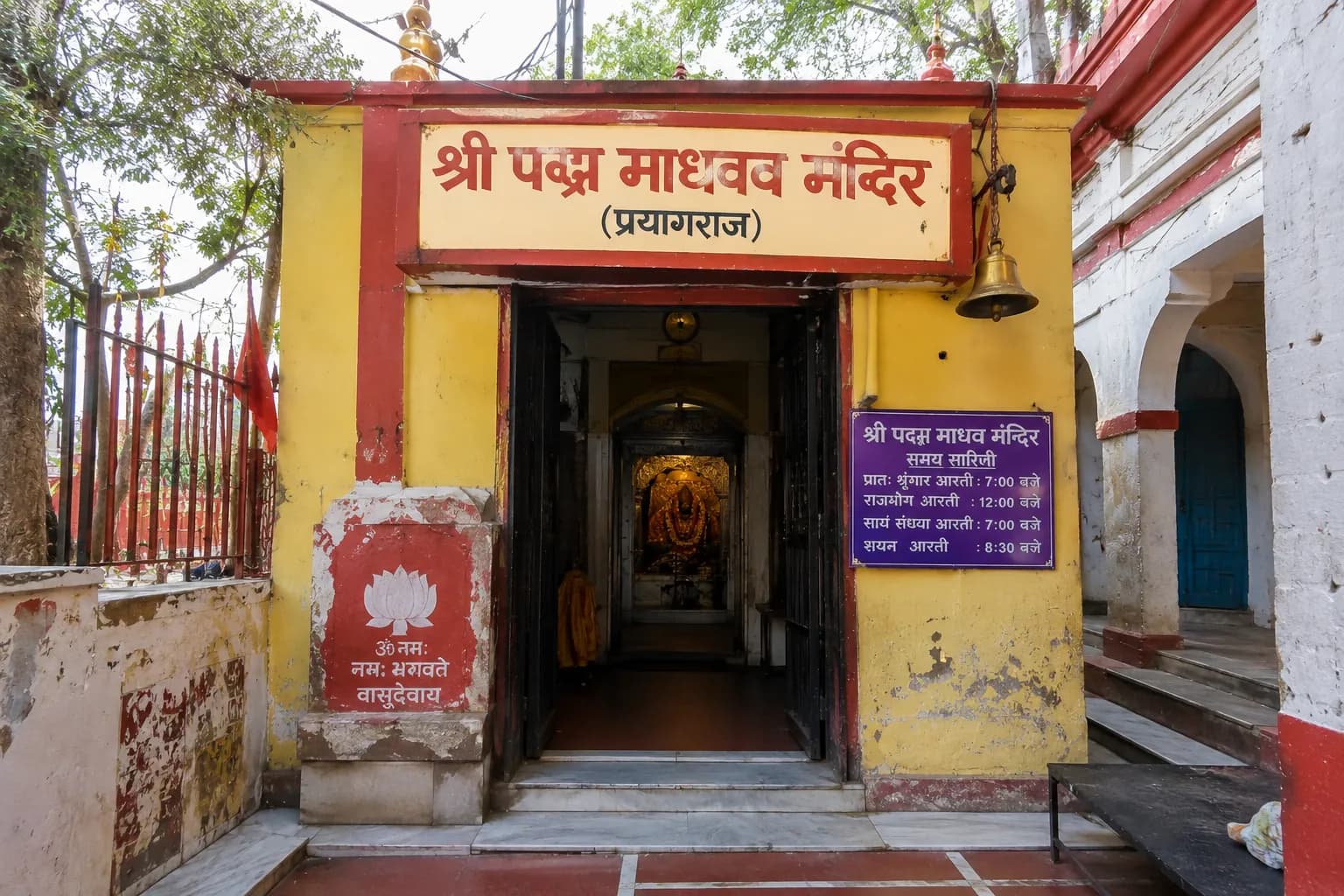
Padma Madhav
The lotus-bearing Lord; purity, creation and the universe. Bikar Devariya.
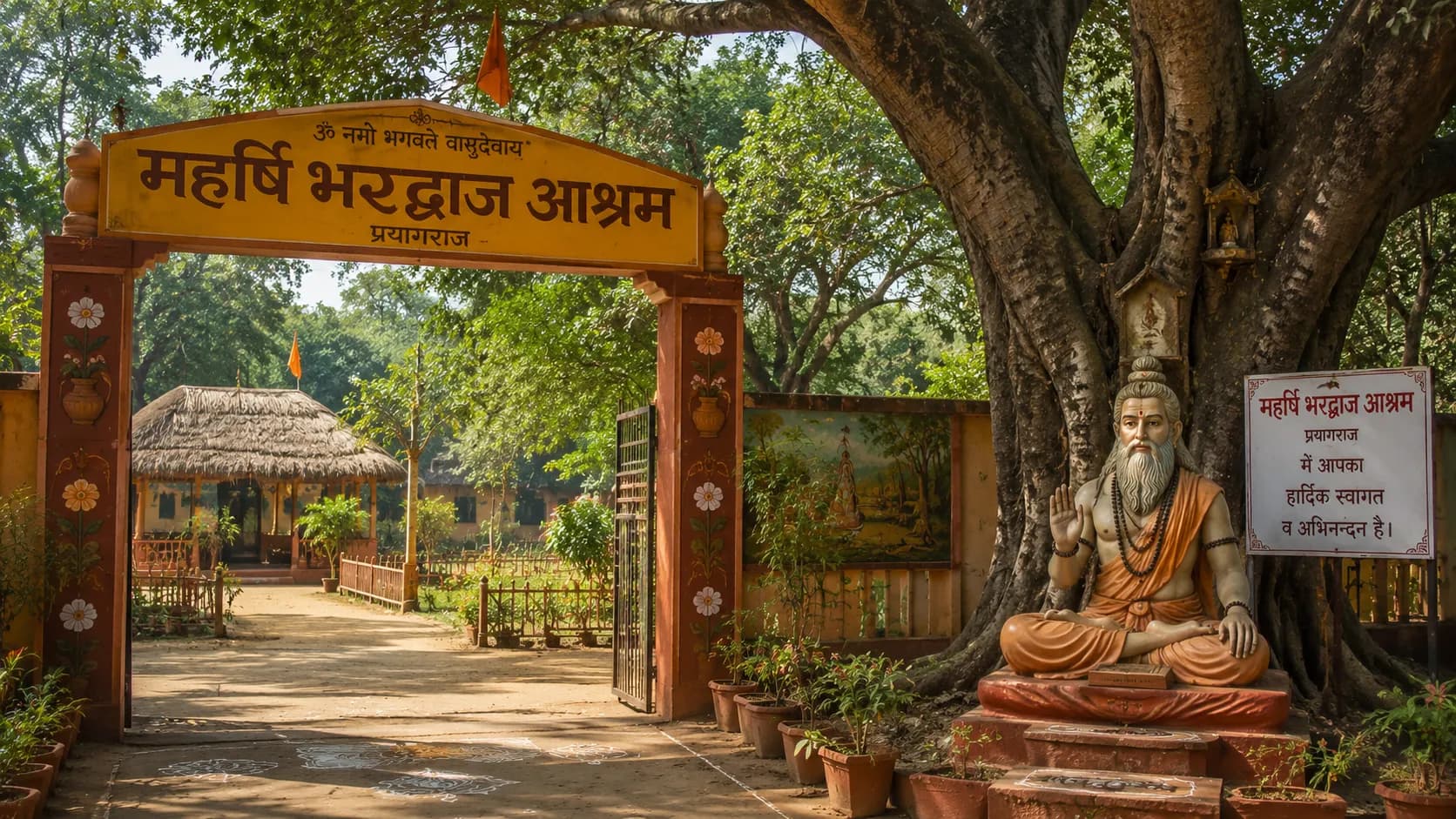
Anant Madhav
The Lord as Ananta, the Infinite; the serpent of eternity. Dhoomanganj.
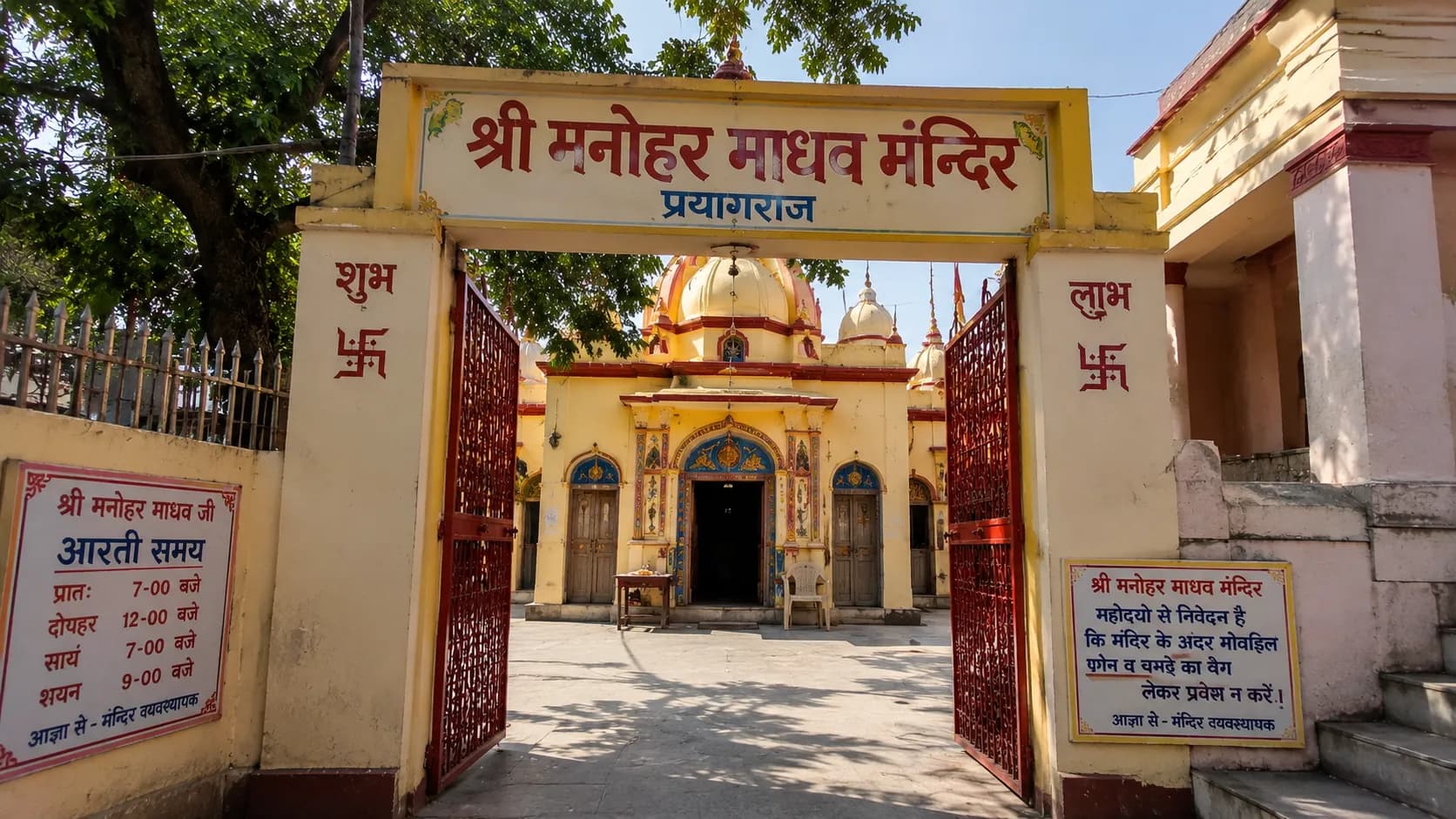
Manohar Madhav
The Enchanting Lord, with Lakshmi; beauty, prosperity, righteousness. Chowk.
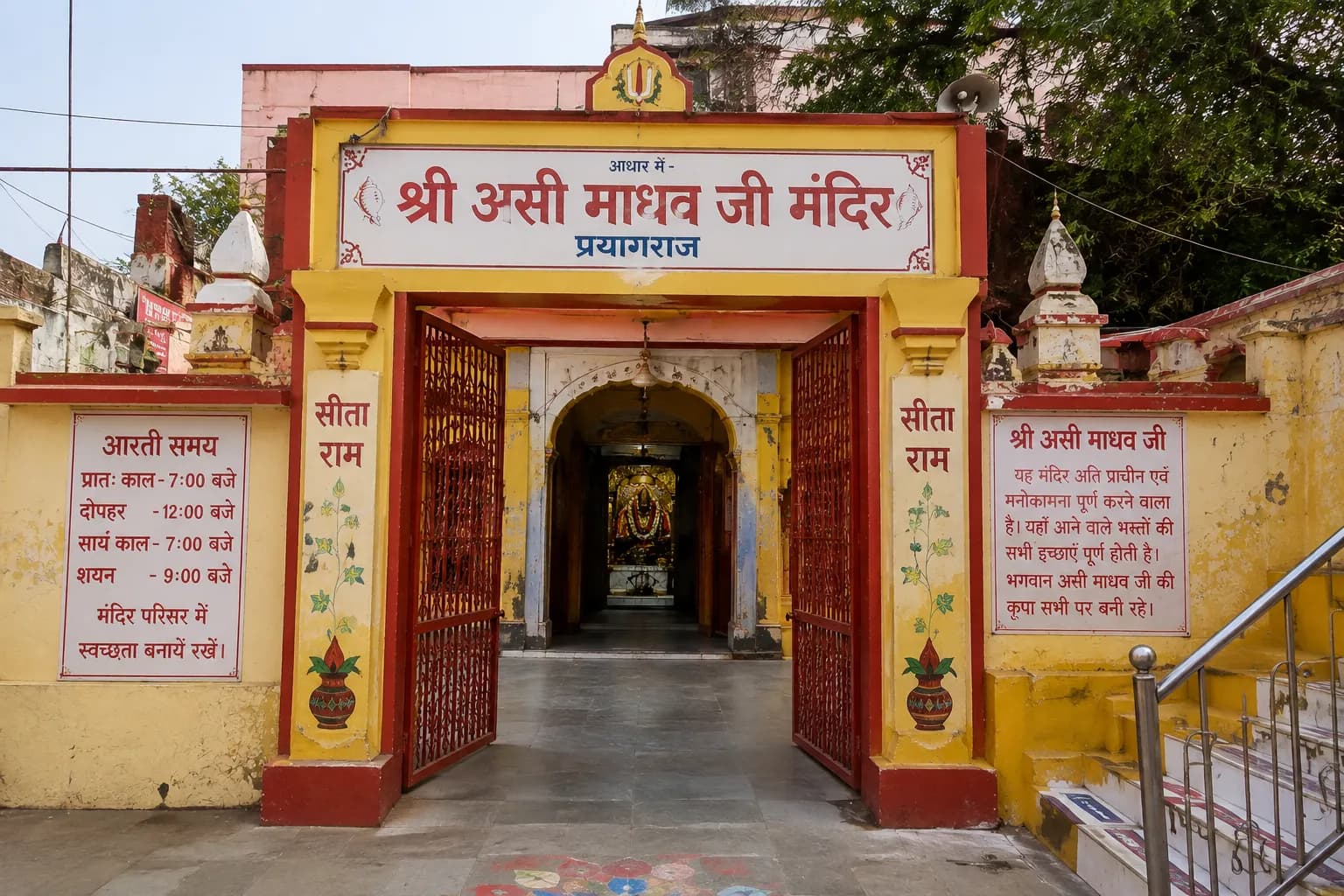
Asi Madhav
The Vishnu of the serpent-shrine, within the Nagvasuki temple. Daraganj.
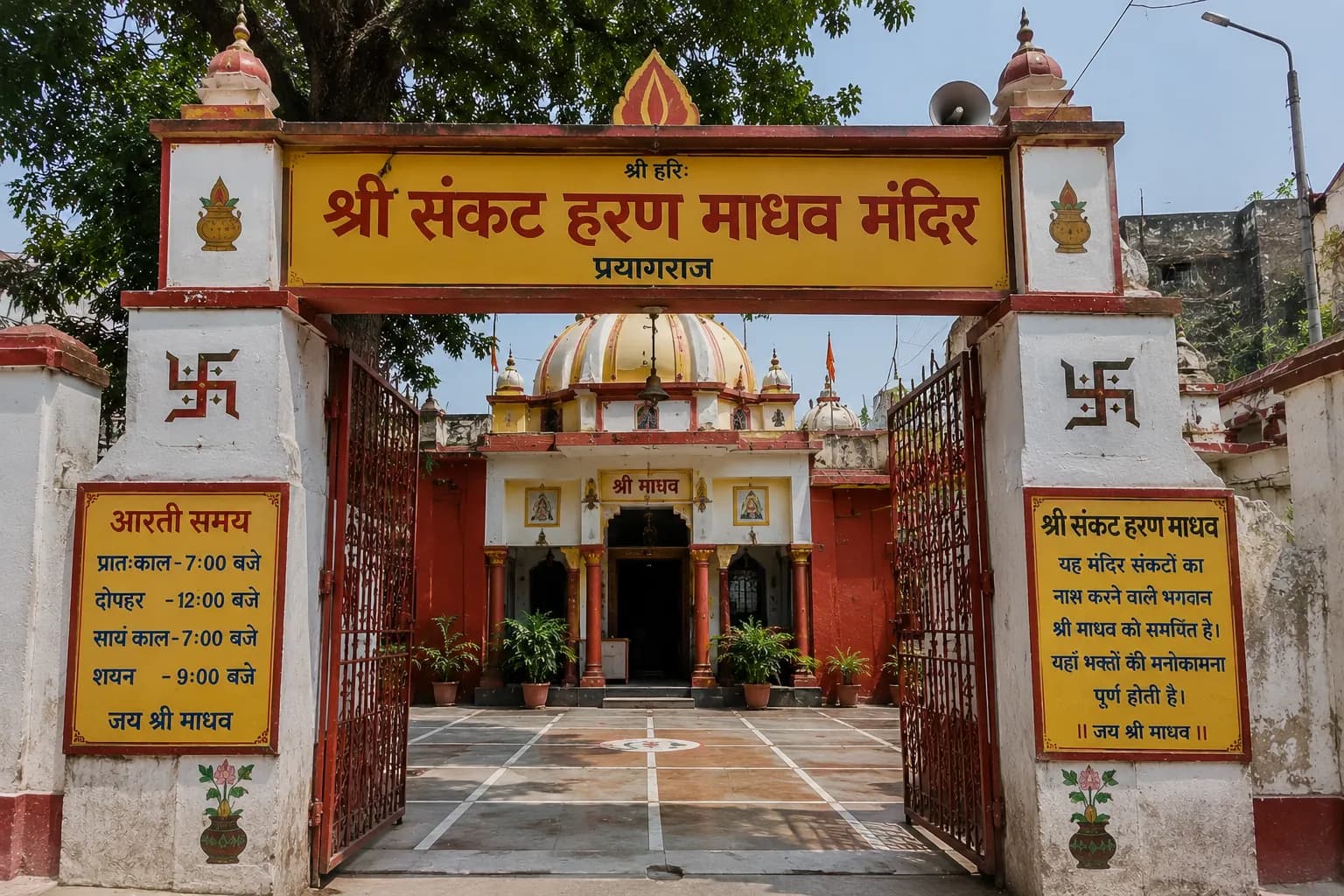
Sankasht Har Madhav
The destroyer of all distress; at the Sandhya Vat banyan. Jhunsi.
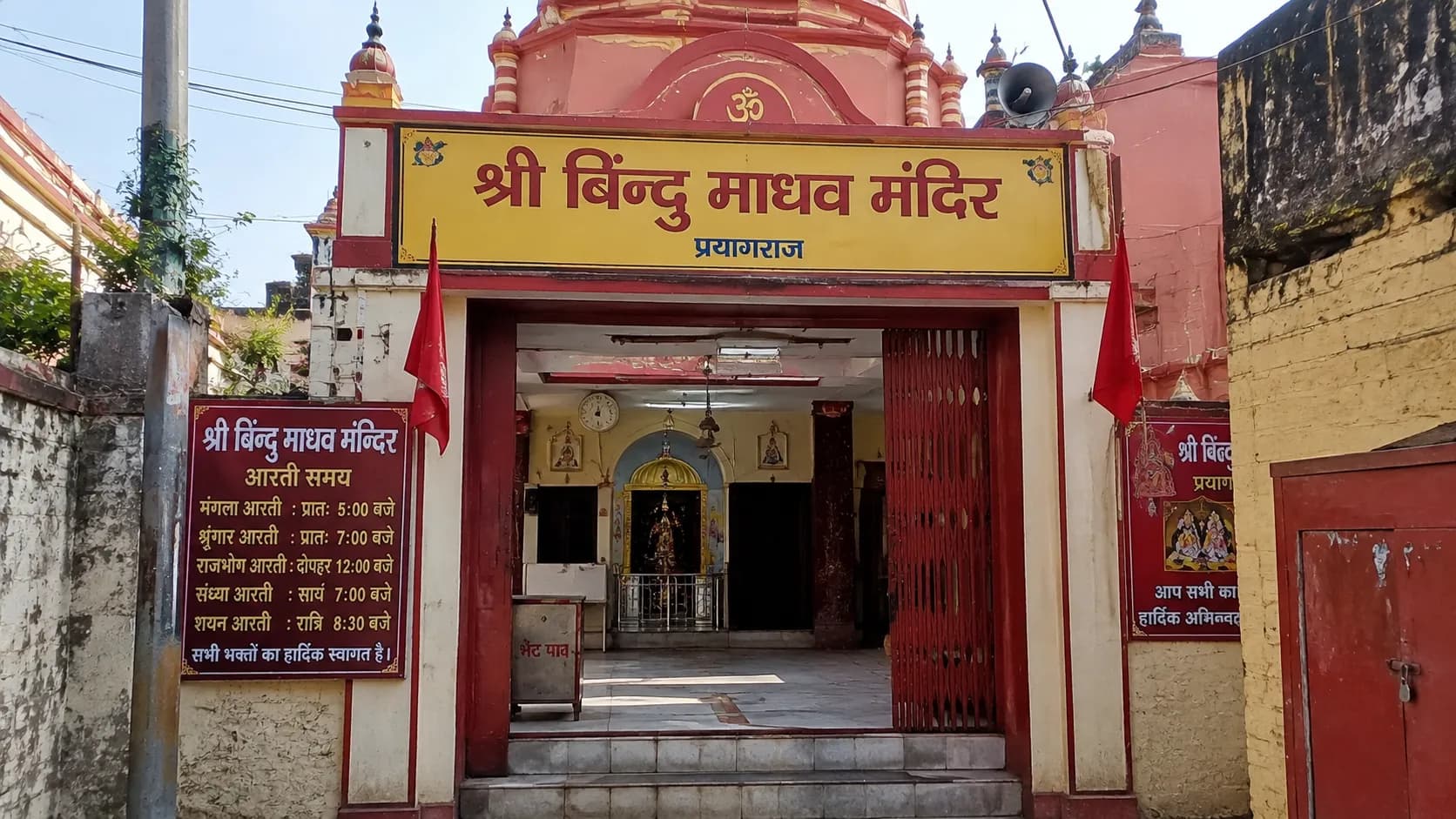
Bindu Madhav
The Vishnu of the sacred drop, the source-point; completes the twelve. Draupadi Ghat.
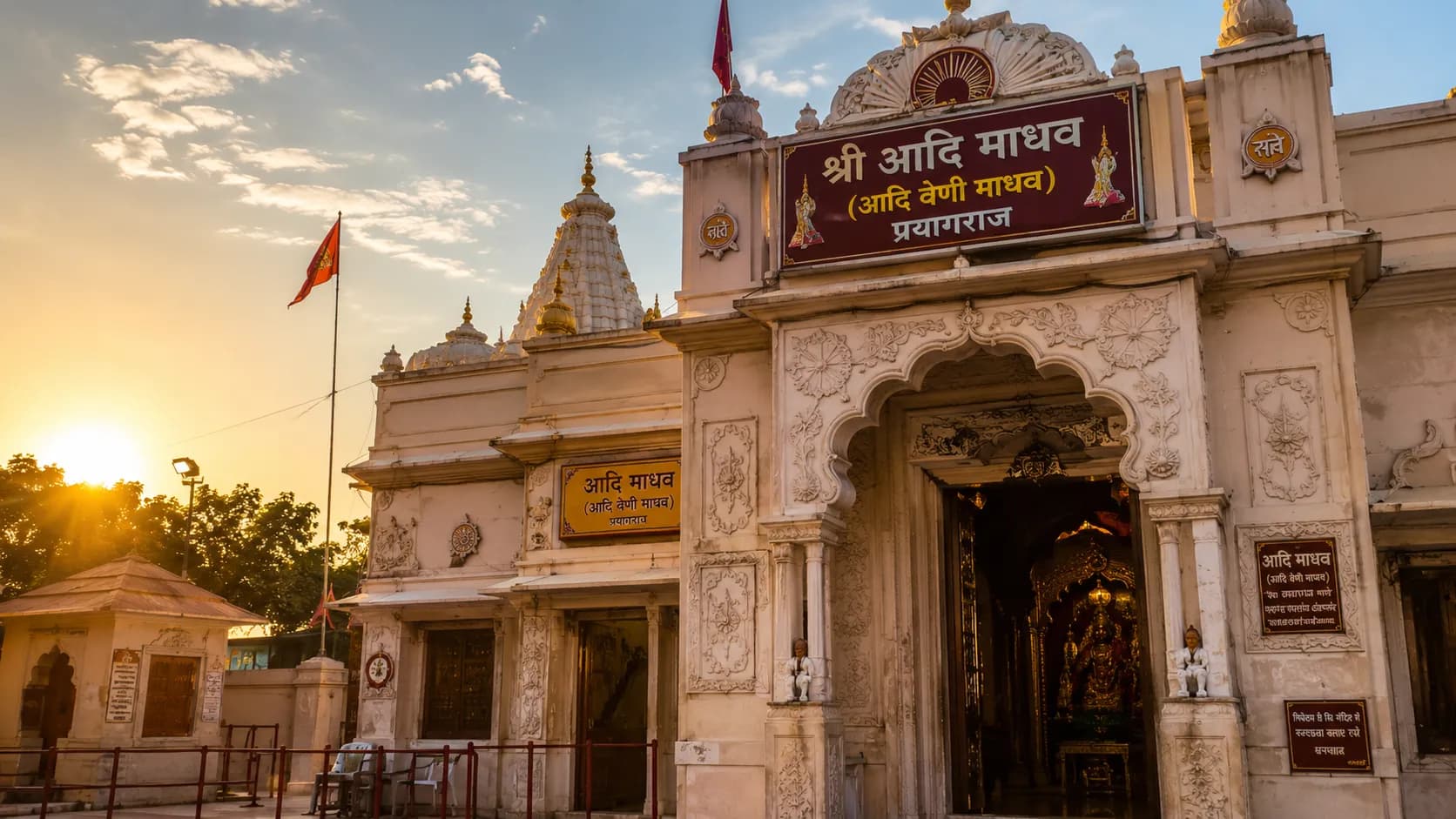
Adi Madhav (Adi Veni Madhav)
The original Veni Madhav, the ancient Vishnu of the confluence; completes the twelve. Arail Ghat, across the Yamuna.
The twelve Madhavs and their orderings vary a little across scriptures and sources; each temple's own guide page carries the detail as we have verified it.
The route and the clusters
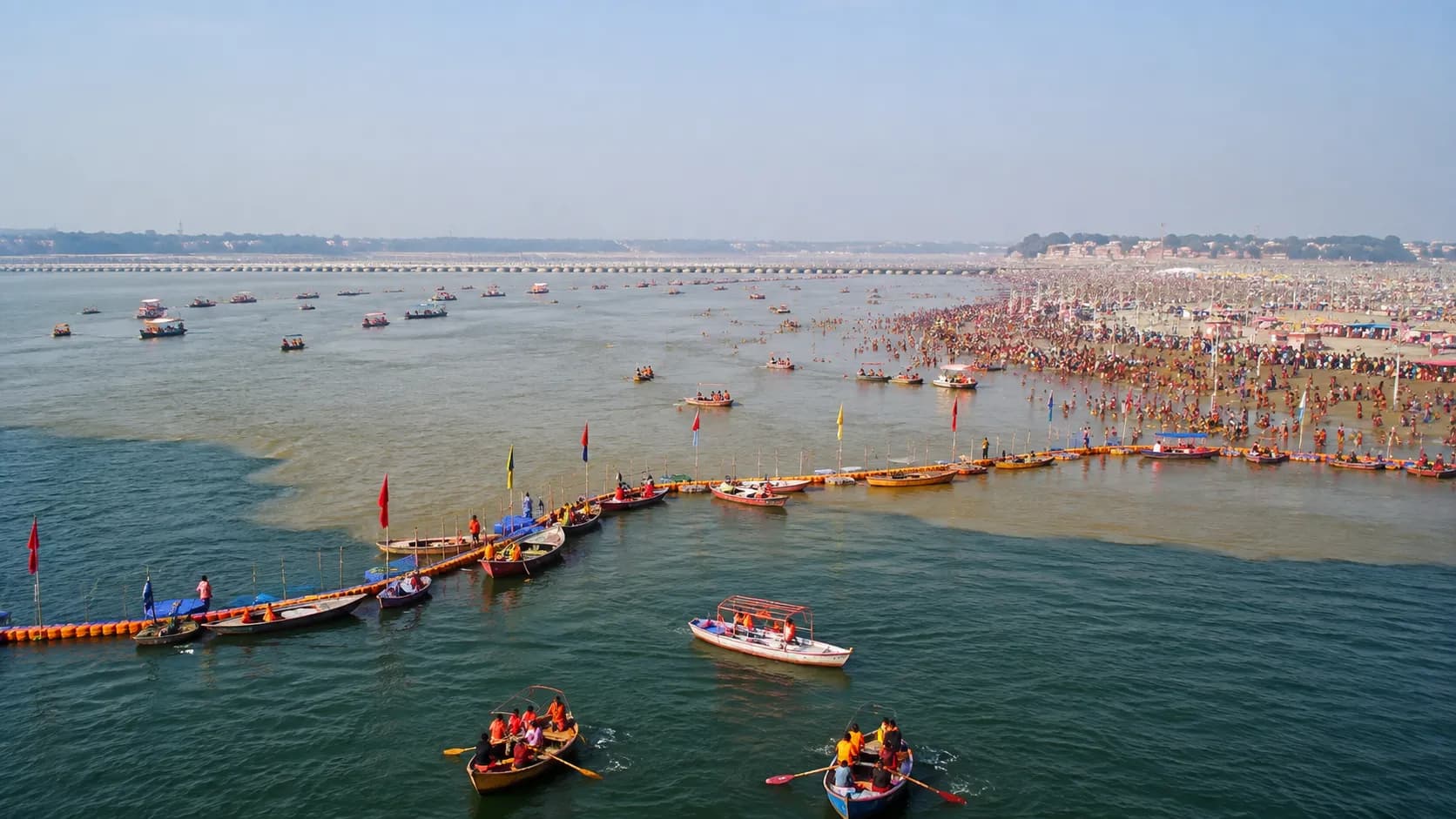
The twelve Madhavs are scattered across the whole sacred landscape of Prayag, on both banks of the Ganga and across the Yamuna, so the parikrama is best planned by their natural clusters. It is the custom to take the holy bath at the Triveni Sangam first, and then to begin the round, most often at the chief Veni Madhav in Daraganj or at the Adi Vat Madhav near the Sangam; and to move through the clusters, using boats to cross to the temples across the rivers.
At each Madhav, the pilgrim offers Tulsi leaves and yellow flowers, and chants the Vishnu Sahasranama, or at the least three recitations of Om Namo Bhagavate Vasudevaya. The full round can be done, with a guide and transport, in a long day or two.
Adi Vat Madhav and the central Madhavs, at the Akshayavat — within the Fort complex by the Sangam. Carry ID.
Veni Madhav (chief), Asi Madhav (inside Nagvasuki) and Bindu Madhav (Draupadi Ghat) — near the Sangam, through narrow lanes, on foot or by auto.
Manohar Madhav, in the Dravyashwarnath temple at Chowk — auto to the old market, then on foot.
Anant Madhav, near the Ordnance Depot — by auto or two-wheeler.
Chakra Madhav (Arail), Gada Madhav (Chhivanki) and Padma Madhav (Bikar Devariya), across the Yamuna — by boat from the Sangam, or by road over the Yamuna bridge.
Shankh Madhav (Chhatnag) and Sankasht Har Madhav (Sandhya Vat), across the Ganga — by boat from the Sangam, or by road over the Shastri Bridge.
Timings, darshan and etiquette
The twelve Madhav temples are all free to enter, with no ticket and no VIP darshan; and most keep a similar split-session pattern, opening around 5:00 or 6:00 AM and closing by evening, with a closure through the middle of the day for the deity's rest.
The best time for the whole round is the early morning, from about 6:00 to 11:00 AM, when the temples are calm; the melas and the Kumbh bring great crowds. Each temple's exact timings are given on its own guide page.
Free at all twelve Madhavs. There is no ticket and no VIP darshan; our charge is only for guiding, the boats, the pandit and arrangements.
Most open around 5:00 or 6:00 AM and close by evening, with a midday closure for the deity's rest.
Tulsi leaves and yellow flowers, pleasing to Lord Vishnu, with the Vishnu Sahasranama or Om Namo Bhagavate Vasudevaya.
Come after the Sangam snan; dress modestly and remove footwear at each shrine; mind the boats and the narrow lanes between clusters.
Best time to do the Parikrama
The most auspicious and traditional time for the parikrama, when the whole city turns to the round.
The days of Vishnu, especially auspicious for the Madhavs.
From about 6:00 to 11:00 AM the temples are calm; allow a long day, or two gentler days.
The most pleasant season for the whole round.
The temples at Arail, Naini and Jhunsi are best reached by boat from the Sangam; we arrange them.
For Prayagraj, the full Dwadash Madhav Parikrama, or a combined Kashi, Ayodhya and Prayagraj pilgrimage, see our tour packages. See tour packages.
Our guided Dwadash Madhav Parikrama
We are a Varanasi, Ayodhya and Prayagraj based operator, a unit of Experience My India, with more than forty years of guiding pilgrims across all three holy cities, and our own local guide and pandit in Prayagraj. Darshan at all twelve Madhavs is free, so what we offer is the whole great round made smooth and meaningful: the Sangam snan and the full circuit, the boats to Arail and Jhunsi arranged, a pandit for the pujas and the ancestral rites, and a guide who tells the story and the grace of each Madhav.
Complete parikrama, one day
The Sangam snan and all twelve Madhavs, with boats, a pandit and a guide.
Parikrama over two days
The full round at an easy pace, with boats, a pandit and a guide.
Parikrama with Pind Daan
The round joined to the ancestral rites, with a pandit and a guide.
Experience My India is a travel operator, not the temples' administration. Darshan at all twelve Madhavs is free; our charge is only for guiding, the boats, the pandit and services. Inclusions and exclusions are stated up front, and no charge appears later that was not named. Timings and rules are set by the temples and can change.
The great round, in my own words
The Dwadash Madhav Parikrama is one of the deepest things I guide, and I love it, because it takes my pilgrims all the way around our holy city, to all twelve forms of the Lord Vishnu who guard Prayag. I explain to them that our old books say the Sangam bath is not truly complete until you have gone round the twelve Madhavs; so this is the crown of the whole pilgrimage.
We start after the Sangam snan, usually at our chief Veni Madhav in Daraganj, and I take them cluster by cluster, by boat across to Arail and to Jhunsi, through the old lanes to the city ones, out to the villages, until all twelve are done. And I love that each Madhav has its own beauty, so the round is never dull: the conch and the discus and the mace and the lotus, the four emblems; the Infinite Anant and the Enchanting Manohar; the one who removes all distress and the one of the sacred drop. I tell them the story of each as we go.
It can be a long day, or gentler over two, and I arrange the boats, the pandit for the pujas, everything. When we finish, at the last Madhav, there is a real sense of completion, of having gone all the way round the Lord's own city. In more than forty years of guiding, walking pilgrims through the whole great round of the twelve Madhavs is among the most complete and fulfilling things I do.
Where the parikrama sits in your yatra
The round of the twelve crowns the Sangam pilgrimage, and Prayagraj itself is one of the three great holy cities that pilgrims visit together.
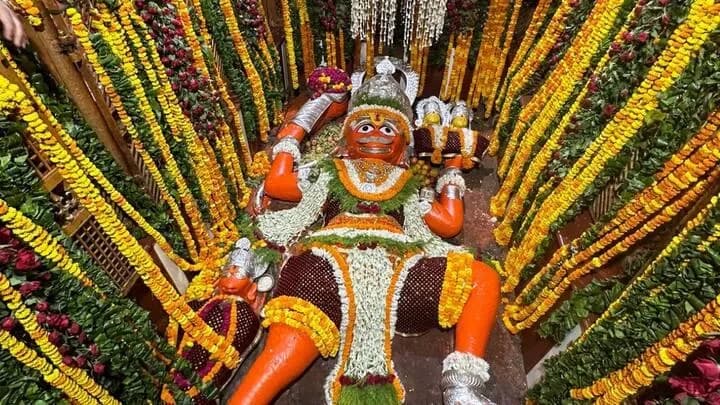
Prayagraj (Prayag)
The full city guide: the Sangam, the temples, the ghats and the heritage.
Varanasi (Kashi)
The eternal city of Lord Shiva, the Ganga ghats and Kashi Vishwanath.
Prayagraj tour packages
The parikrama, the Sangam and the three-city pilgrimage, planned end to end.
Frequently asked questions
What is the Dwadash Madhav Parikrama?+
The sacred circuit of the twelve Madhavs, the twelve forms of Lord Vishnu that guard Prayag; it is undertaken as the crown and completion of the Sangam pilgrimage.
How many Madhav temples are there?+
Twelve, the Dwadash Madhav, set at the twelve points around the sacred field of Prayag; each has its own character and place.
Why is the parikrama important?+
The full fruit of the Sangam bath is held to be realised only upon completing the round of the twelve; it is equal in merit to encircling the cosmos, and it empowers the ancestral rites.
Where should I begin?+
Take the Sangam snan first, then begin at the chief Veni Madhav in Daraganj or at the Adi Vat Madhav near the Sangam, and go round by cluster.
How long does it take?+
The full round can be done in a long day with transport and boats, or gently over two days.
Do I need boats?+
Yes, for the temples across the rivers, at Arail and Naini (across the Yamuna) and at Jhunsi (across the Ganga); we arrange them.
Is there any fee?+
No. Darshan at all twelve Madhavs is free; our charge is only for guiding, the boats, the pandit and services.
What do I offer?+
Tulsi leaves and yellow flowers, pleasing to Lord Vishnu, with the chanting of the Vishnu Sahasranama or Om Namo Bhagavate Vasudevaya.
When is the best time?+
The month of Magh and the Kumbh, on Ekadashi and Dwadashi, and in the early morning; winter is the most pleasant season.
Who established the twelve Madhavs?+
The tradition holds that Lord Brahma established them after the first cosmic yajna at Prayag, to guard the sacred field; the parikrama was revived in 1961.
Visiting Dwadash Madhav Parikrama?
Our guided packages bundle VIP darshan, a local guide, stays, and private transport across the whole circuit — so you spend the day at the temple, not in queues.
See tour packages →